Definitions
Probiotics and fermented foods both play roles in gut health, but they are not the same. Probiotics are live microorganisms that, when given in adequate amounts, provide a health benefit to the person consuming them. This definition comes from expert groups like the International Scientific Association for Probiotics and Prebiotics (ISAPP).
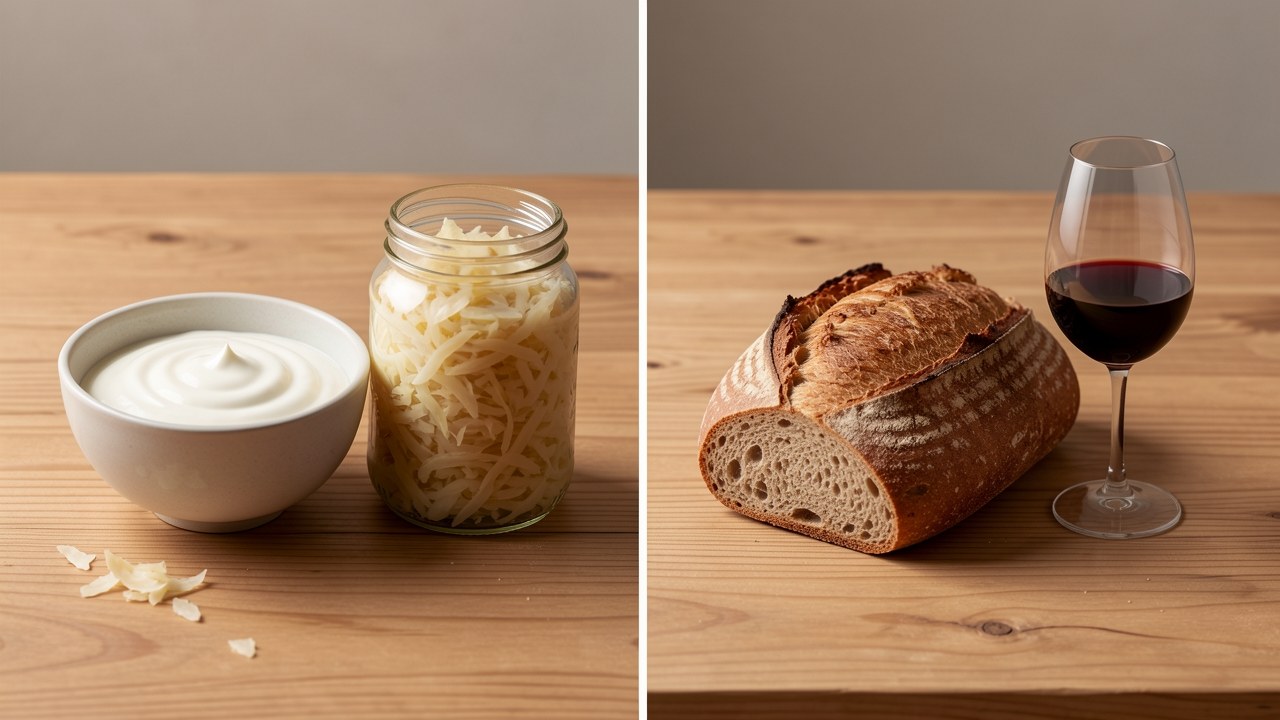
Fermented foods, on the other hand, are foods made through the growth of desired microbes and the enzymatic changes they cause in food ingredients. That includes yogurt, kefir, sauerkraut, kimchi, and also bread, beer, and wine. Not every fermented food contains live microbes at the time you eat it, and not every microbe in a fermented food has a proven health benefit.
- Probiotics must be live microorganisms.
- Probiotics must have a demonstrated health benefit, typically shown in at least one clinical trial.
- Fermented foods are defined by how they are made, not by whether they are probiotic.
- The terms 'fermented food' and 'probiotic' should not be used interchangeably.
Sources: Canadian Digestive Health Foundation, International Scientific Association for Probiotics and Prebiotics (ISAPP), Nature Reviews Gastroenterology & Hepatology
How Fermentation Works and Its Purposes
Fermentation relies on microorganisms such as bacteria, yeast, or molds to convert sugars and other components in food into compounds like lactic acid, alcohol, and carbon dioxide. This process can preserve food, change its flavor and texture, and may also create beneficial compounds for health.
In some foods, the microbes doing the fermentation are the same ones that end up as live cultures in the final product, but this is not always the case. For example, in yogurt, specific bacterial strains are part of the starter culture and drive the fermentation. In other fermented products like kombucha, probiotics may be added after the fermentation process is complete.
- Fermentation uses microbial growth and enzyme activity to change food.
- It produces acids and alcohol that help preserve food and shape its taste.
- The role of microbes varies: some are starter cultures, others may be added later.
- The final product may or may not retain live microbes.
Sources: Nature Reviews Gastroenterology & Hepatology, Stanford Medicine
Why Not All Fermented Foods Contain Live Probiotics
Many common fermented foods are processed after fermentation in ways that remove or kill the live microorganisms. Bread is baked, beer and wine are filtered and sometimes pasteurized, and chocolate undergoes roasting. All of these steps reduce or eliminate live microbes.
Even when live microbes remain, they are not automatically probiotics. A microbial strain is only called a probiotic if scientists have shown that it provides a health benefit when taken in adequate amounts. Most fermented foods do not meet this standard because the microbes in them have not been identified to the strain level, and their specific health benefits have not been demonstrated.
Pasteurization, often used for dairy products, also kills bacteria. However, some manufacturers add probiotics back to a product after pasteurization, so it can still be considered a probiotic food if the added strains meet the criteria.
- Heat, baking, roasting, and filtration can inactivate microbes.
- Pasteurized fermented foods often lack live cultures unless probiotics are added back.
- A health benefit must be proven for a product to be labeled a probiotic food.
- Because of these factors, most fermented foods are not probiotic foods.
Sources: Canadian Digestive Health Foundation, International Scientific Association for Probiotics and Prebiotics (ISAPP), Children's Hospital of Philadelphia (CHOP)
Examples of Fermented Foods With and Without Live Cultures
Some fermented foods are typically sold with live cultures. Yogurt and kefir, for instance, are often made with live bacterial cultures, though not all yogurt retains them after processing. Unpasteurized sauerkraut and traditional kimchi are also common sources of live microbes.
On the other hand, many fermented foods are usually consumed without live cultures. Bread, chocolate, beer, and wine are common examples because they are baked, roasted, or filtered after fermentation. Shelf-stable products that are acidified with vinegar rather than genuinely fermented may also lack live cultures.
The presence of live cultures depends on the specific product, its processing, and how it is stored. Reading labels and understanding the production method can help you identify which fermented foods might offer live microbes.
- Often contain live cultures: yogurt, kefir, unpasteurized sauerkraut, kimchi.
- Usually lack live cultures: bread, chocolate, beer, wine.
- Pasteurized versions of sauerkraut and kimchi may have no live cultures.
- Products simply acidified with vinegar may not be truly fermented.
Sources: Canadian Digestive Health Foundation, International Scientific Association for Probiotics and Prebiotics (ISAPP), Stanford Medicine, Children's Hospital of Philadelphia (CHOP)
Comparison Table: Fermented vs. Probiotic Foods
The table below summarizes the key differences between fermented foods and probiotic foods as categories.
| Aspect | Fermented Foods | Probiotic Foods |
|---|---|---|
| Definition | Foods made through desired microbial growth and enzymatic conversions of food components. | Foods containing live microorganisms that confer a health benefit when consumed in adequate amounts. |
| Live microbes required? | No. | Yes, must contain live microorganisms. |
| Demonstrated health benefit required? | No. | Yes, the strain must be shown to confer a health benefit. |
| Examples | Yogurt, kefir, sauerkraut, kimchi, beer, wine, bread. | Some yogurts and kefir with specific probiotic strains. |
Sources: Canadian Digestive Health Foundation, International Scientific Association for Probiotics and Prebiotics (ISAPP), Nature Reviews Gastroenterology & Hepatology
Label-Reading Cues to Identify Live Cultures
If you want fermented foods with live cultures, the first step is to check the label. Look for phrases like 'live active cultures' on yogurt and other dairy products. If a product is pasteurized after fermentation, it usually will not have live cultures unless the label indicates that probiotics were added back.
For products like sauerkraut or kimchi, look for unpasteurized or refrigerated versions, which are more likely to retain live cultures. Be cautious with shelf-stable items: they may be made by acidification rather than true fermentation, and they will not contain live microbes.
Also remember that live cultures are not the same as probiotics. Even a yogurt with 'live active cultures' may not have strains with proven health benefits. To call a food a probiotic, both live cultures and demonstrated benefits are needed.
- Check for 'live active cultures' on dairy labels.
- Look for unpasteurized and refrigerated sauerkraut or kimchi.
- Be aware that pasteurization kills live cultures unless added back later.
- Live cultures do not automatically make a product a probiotic.
Sources: Children's Hospital of Philadelphia (CHOP), Stanford Medicine
Evidence on the Health Effects of Fermented Foods Without Live Cultures
Fermented foods that lack live cultures may still offer health benefits. The fermentation process produces metabolites and can increase the availability of certain nutrients. Some research suggests that these compounds, independent of live microbes, could have positive effects on health, but the evidence is still emerging.
It is important to note that the scientific community does not yet have conclusive evidence about the health effects of consuming fermented foods without live cultures. While these foods can be part of a healthy diet, they should not be assumed to provide the same benefits as probiotic foods with demonstrated live-culture effects.
- Fermentation can produce beneficial metabolites and enhance nutrient bioavailability.
- Some health effects may occur even without live microbes.
- Evidence is not yet conclusive, so more research is needed.
- Do not assume that a fermented food without live cultures has probiotic benefits.
Sources: Stanford Medicine, Frontiers in Microbiology
Side-by-Side Category and Decision-Criteria Matrix
When deciding whether a fermented food is likely to provide live cultures and potentially probiotic benefits, consider the following categories and criteria. The table below can serve as a practical guide for reading product labels and making informed choices.
| Category | Criteria to Identify | Likely Contains Live Cultures? |
|---|---|---|
| Unpasteurized fermented foods | Look for refrigeration and 'unpasteurized' or 'raw' on the label. | Yes, typically. |
| Pasteurized fermented foods | Look for 'pasteurized' on the label or shelf-stable packaging. | No, unless probiotics are added back. |
| Pasteurized with added probiotics | Check for specific probiotic strains listed on the label. | Yes, if the added strains survive. |
| Acidified (not truly fermented) | Ingredients may include vinegar; product is shelf-stable. | No, typically not. |
Sources: Stanford Medicine
Frequently asked questions
Can sauerkraut and kimchi provide probiotics if pasteurized?
No, pasteurization uses heat to kill microorganisms, so pasteurized sauerkraut and kimchi will not contain live cultures. If you want these foods for their live bacteria, choose unpasteurized, refrigerated versions.
Sources: Canadian Digestive Health Foundation, Children's Hospital of Philadelphia (CHOP)What's the easiest way to tell if a fermented food still has live cultures?
The easiest way is to check the product label. Look for terms like 'live active cultures' on dairy products, or 'unpasteurized' on items like sauerkraut. Refrigerated products are more likely to have live cultures, while shelf-stable items often have been heat-treated and lack them.
Sources: Children's Hospital of Philadelphia (CHOP), Stanford MedicineDoes cooking destroy probiotics in fermented foods?
Yes, cooking and other high-heat processes destroy live microorganisms. If you bake with yogurt or cook sauerkraut, the probiotic cultures will be inactivated. To benefit from live cultures, it is best to consume fermented foods that have not been heated after fermentation.
Sources: Canadian Digestive Health Foundation, Children's Hospital of Philadelphia (CHOP)Sources
- Probiotics vs Fermented Foods — Canadian Digestive Health Foundation
- Do fermented foods contain probiotics? — International Scientific Association for Probiotics and Prebiotics (ISAPP)
- The International Scientific Association for Probiotics and Prebiotics (ISAPP) consensus statement on fermented foods — Nature Reviews Gastroenterology & Hepatology
- The Science of Fermented Foods — Stanford Medicine
- Myth-Busting Fermented Foods — Stanford Medicine
- Food as Medicine: Probiotic Foods — Children's Hospital of Philadelphia (CHOP)
- How to Recognize Fermented Foods — Stanford Medicine
- Fermented foods: a perspective on their role in delivering biotics — Frontiers in Microbiology